
Tris(methylcyclopentadienyl)yttrium(III)
Synonym: Y(MeCp)3, Tris[(1,2,3,4,5-H)-1-Methyl-2,4-Cyclopentadien-1-Yl]-
MFCD00145485 | 630-916-1
Tris(methylcyclopentadienyl)yttrium(III), also designated by product code Y5720 (CAS 329735-72-0), is a high-purity organometallic yttrium(III) complex supplied as yellow crystals with a 99.9%-Y metal purity.
Characterized by its excellent volatility, Y(MeCp)3 boasts the highest vapor pressure among surveyed yttrium precursors. This exceptional property is critical for achieving optimal growth rates in Metal-Organic Chemical Vapor Deposition (MOCVD) processes. Due to its extreme air and moisture sensitivity, this flammable, water-reactive solid must be handled strictly under an inert atmosphere.
In thin-film applications, this chemical serves as a premier precursor for the Atomic Layer Deposition (ALD) of yttria (Y2O3). It is also widely used to grow complex oxides like Yttria-Stabilized Zirconia (YSZ) when paired with a zirconium precursor, and YScO3 when combined with ScCp3. Notably, films deposited using Y(MeCp)3 exhibit significantly lower carbon and hydrogen impurity levels compared to alternative options, ensuring superior structural and electronic film quality.
*This product is intended strictly for research and development usage and is not listed in the TSCA registry.*

Overview
Ereztech manufactures and sells this product in small and bulk volumes. Glass ampules, bottles or metal ampules or bubblers are available for packaging. For additional analytical information or details about purchasing Tris(methylcyclopentadienyl)yttrium(III) contact us at sales@ereztech.com
| Product Code | Y5720 |
| Product Name | Tris(methylcyclopentadienyl)yttrium(III) |
| CAS Number | 329735-72-0 |
| Molecular formula | C18H21Y |
| Linear formula | Y(C6H7)3 |
| Molecular weight | 326.27 |
| Form | solid |
| Melting point | 122-123C |
| UOM | KG |
| Sensitivity | air, moisture |
Test Specification
| Assay (purity) | 98%+ |
| Purity method | by titration |
| Metal purity | 99.9%-Y |
| Appearance | yellow crystals |
| Titration | %Y=26.7-27.8 |
| Titration notes | complexometric |
Applications
Y₂O₃ thin film deposition by ALD/CVD
Y(MeCp)₃ serves as a premier precursor for the Atomic Layer Deposition (ALD) and Chemical Vapor Deposition (CVD) of pure yttria (Y₂O₃) thin films.
YSZ (yttria-stabilized zirconia) — use with zirconium precursor
Widely used for growing complex YSZ layers when paired with a compatible zirconium precursor, ensuring reliable structural quality.
YScO₃ high-k dielectric — use with ScCp₃
Applied in semiconductor manufacturing research for high-k gate dielectrics, deposited in combination with ScCp₃ precursors.
MOCVD process development and validation
Y(MeCp)₃ has the highest vapor pressure of surveyed yttrium precursors — critical for optimizing MOCVD growth rates.
Safety Information
| Signal word | DANGER |
| Pictograms | 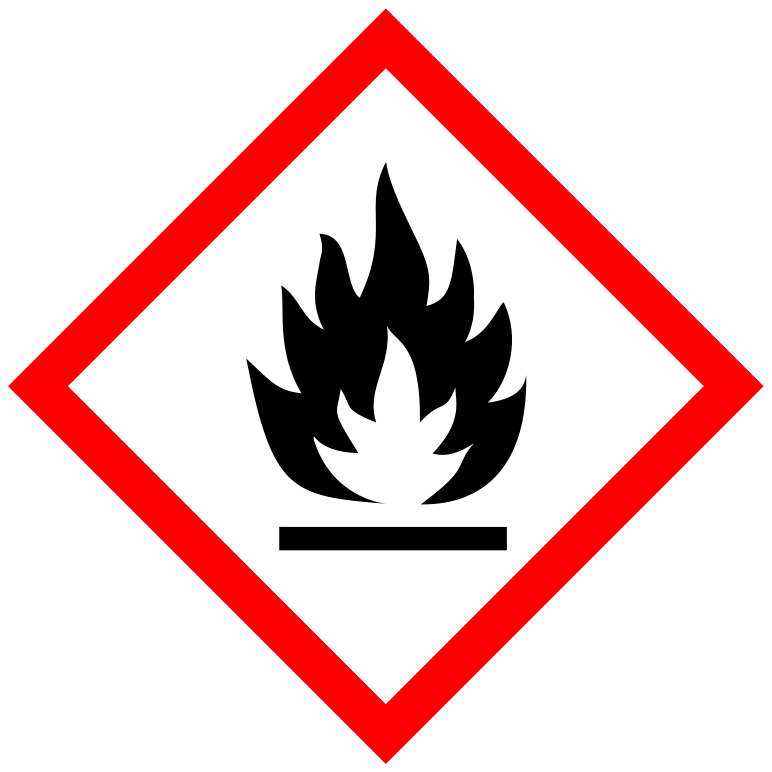  |
| UN | 3396 |
| Transport description | Organometallic substance, solid, water-reactive, flammable Tris(methylcyclopentadienyl)yttrium |
| Hazardous class | 4.3(4.1) |
| Packing group | II |
| In TSCA registry | No (sold for research and development usage only) |
Frequently Asked Questions
Literature & Technical References
Peer-reviewed research and academic citations validating the deposition performance, thermal stability, and methodologies of Tris(methylcyclopentadienyl)yttrium(III).
Päiväsaari et al.
"Rare Earth Oxide Thin Films." Topics in Applied Physics, 2007.
Myllymäki et al.
"Atomic Layer Deposition of High-k Dielectrics." J. Mater. Chem., 2006.
Related Products
Y(Cp)₃
Y(MeCp)₃
Y(EtCp)₃
Y(iPrCp)₃
Y(nBuCp)₃
(EtCp)2YCl
The breadth of this portfolio matters. Different Cp ligand substitutions - methyl, ethyl, isopropyl, n-butyl - deliver meaningfully different volatility profiles, decomposition temperatures, and film growth rates. Having access to the full family from a single qualified supplier simplifies precursor screening and accelerates process development.